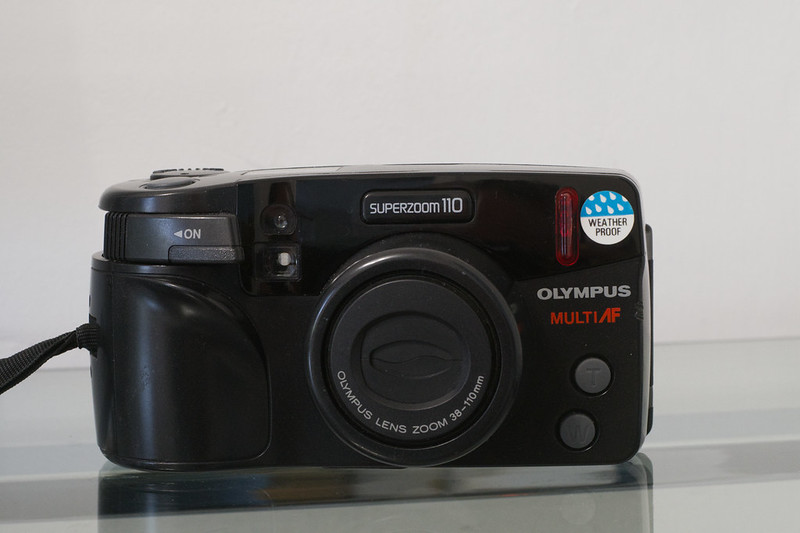
Also known as the Infinity Zoom 3000 and OZ Zoom 110, it was announced at the 1992 PMA show as the smallest superzoom point and shoot camera. It really is an example of efficient use of space and yet ‘cramming’ in all the features. Made of plastic, the camera is light and I found I could put it easily in my coat pocket. The oversized grip makes for an enjoyable one handed experience.
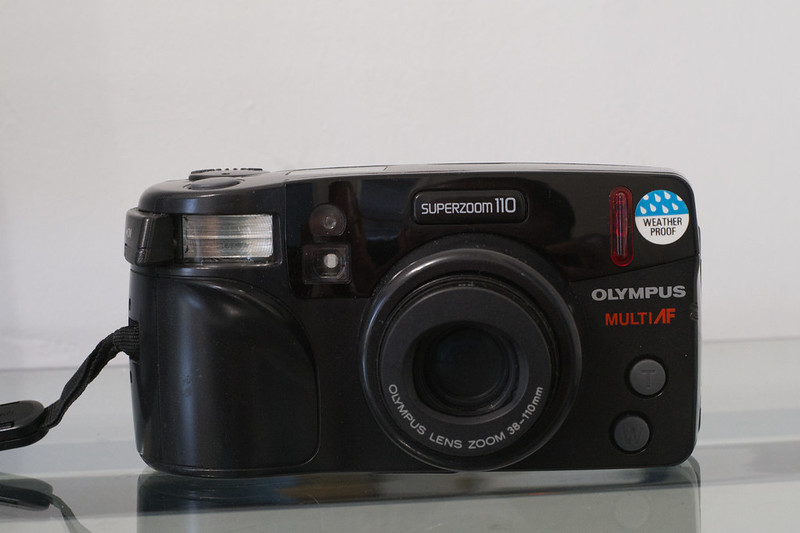
What do we find behind the power button?…. a flash which has auto, auto s for red eye reduction, fill in flash and no flash settings.

One of the headline features is the zoom which ranges from 38mm to, you guessed it.. 110mm. the above image shows the zoom at 110mm

Weather proof but not deep sea diving proof!

Olympus went for a menu driven route to access the features of the Superzoom 110. By holding down the menu button on the back and moving the menu select dial on the top you get to select the flash modes. It was really nice to see the inclusion of a viewfinder diopter adjustment, a real feature worth having as a spectacle wearer. The viewfinder is bright and has a central crosshair and close up correction markers etched in the viewfinder. A Orange/ Green LED tells you you have acquired focus and whether flash is activated. Another nice feature is a mid roll rewind function, situated between the menu and remote/self timer buttons.

Press the menu button again and you get to select picture modes. The mountain icon represents infinity mode. The next one up is the AF-P mode which according to the manual is for subjects approaching you , the zoom will adjust accordingly. Next up is night scene mode when the camera will employ slow shutter speeds and flash if you so desire. The penultimate mode is a form of scene tracking mode. Finally you can select spot mode for those times when you want a subject that is not in the centre of the scene to be sharp in focus.

So how did the camera perform? Judge for yourself. All images are straight out of the camera with only dust removed.


Having been gifted with the camera I wasn’t certain if it worked so I put a small amount of film in it. The only noise comes when you turn it on and when the film is rewound. Otherwise the camera is rigged for silent running.


I have to admit I am really delighted with the Superzoom 110. The camera for the most part exposes correctly, focuses with supreme ease and the lens is capable of producing sharp images. What’s not to like? Well, all is not perfect as the following two images demonstrate.


On both occasions the zoom was extended all the way to 110mm. What is going on?
Despite this, the Superzoom 110 is a really enjoyable camera to use. Being able to slip it into a coat pocket on a walk and to know that it is a capable performer, like I say what’s not to like?I wish I had put more film in. Oh well I will just have to go out another time with it.😀
 arhphotographic
The last two images have the same effect as I’ve seen on any number of Olympus Stylus Epic Zoom 80 cameras, including the two I’ve owned. The thinking is that there’s a rubber seal around the lens that deteriorates and lets light in, in that curved pattern. It’s probably the same root cause on this camera. On this camera perhaps the effect only is possible at max zoom.
LikeLike
What a shame. I really enjoyed my time with it. Good job we have clone tool that mitigates the effect and allows for continued use.
LikeLike
One of the reasons I sold my Zoom 80 is because there were times I simply couldn’t edit out the leak because what it covered was too complex for Photoshop. It was a shame, because that was such a lovely little camera.
LikeLike